Protocol plugins
OPC UA and MQTT from day one; Modbus TCP is in development and will let eco2node serve as a full Modbus gateway. Every protocol is a self-contained plugin — new protocols arrive while existing installations keep running untouched.

eco2node connects machines, PLCs, and meters from any manufacturer to eco2lot — secures every measurement series locally and gives you controlled access down to each individual data point.
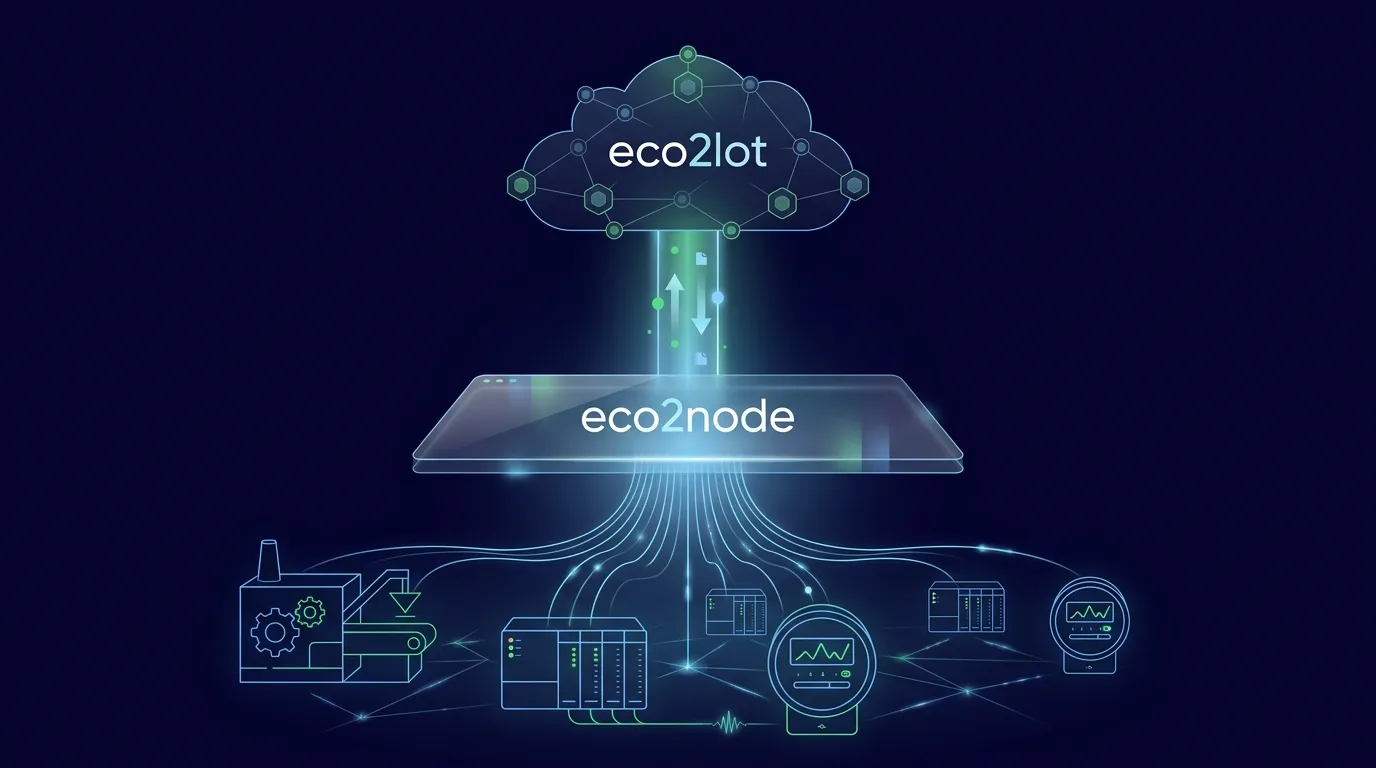
In grown plants, valuable data sits everywhere — in PLC systems (the “brain” of every machine), in OPC UA servers, Modbus devices, energy meters, and building technology. Every system speaks its own protocol. Anyone who wanted to use this data centrally used to struggle with isolated tools, vendor lock-in, and data gaps after every connection loss.
eco2node solves this with one unified local software layer: the Industrial Edge Operating System. “Edge” stands for edge computing: the software runs directly on site, close to the machine — where the data is created. eco2node collects it, unifies it, and connects it securely to the eco2lot platform.
Each data point receives a central tag ID with unit, limit values, and write permission. You work with readable names instead of cryptic register addresses — independent of manufacturer and protocol.
You also decide where your data goes: eco2node works standalone, independent of the eco2lot platform, and writes time series directly into your own database — for example SQL or PostgreSQL.
OPC UA and MQTT from day one; Modbus TCP is in development and will let eco2node serve as a full Modbus gateway. Every protocol is a self-contained plugin — new protocols arrive while existing installations keep running untouched.
Every value gets a central tag ID with name, unit, limit values, scaling, and write permission. Whether the value comes from an OPC UA node or an MQTT topic makes no difference to eco2lot.
Time series are secured locally first. After a connection loss, eco2node automatically retransmits the buffered data — in chronological order, with original timestamps, free of duplicate transmissions.
TLS-encrypted MQTT in both directions: readings, states, and diagnostics upstream — configurations, read requests, and approved write commands downstream.
Query current values directly from the device or change approved setpoints — role-based, with value ranges, audit log, and write-and-readback: eco2node confirms that the device accepted the value.
Online status, buffer levels, software versions, and connection quality of all instances in one overview — from a pilot site to a fleet with thousands of devices.
eco2node runs locally at your site and talks to machines, controllers, and meters — via OPC UA and MQTT at launch.
Every reading gets a central tag ID and is stored locally as a time series first. Connection losses cost you zero data.
Data flows to eco2lot over a TLS-encrypted MQTT connection — and configurations, read requests, and approved write commands flow back.
In eco2lot you visualize, analyze, and set alarms — and, when needed, reach down to each individual data point in a controlled way.
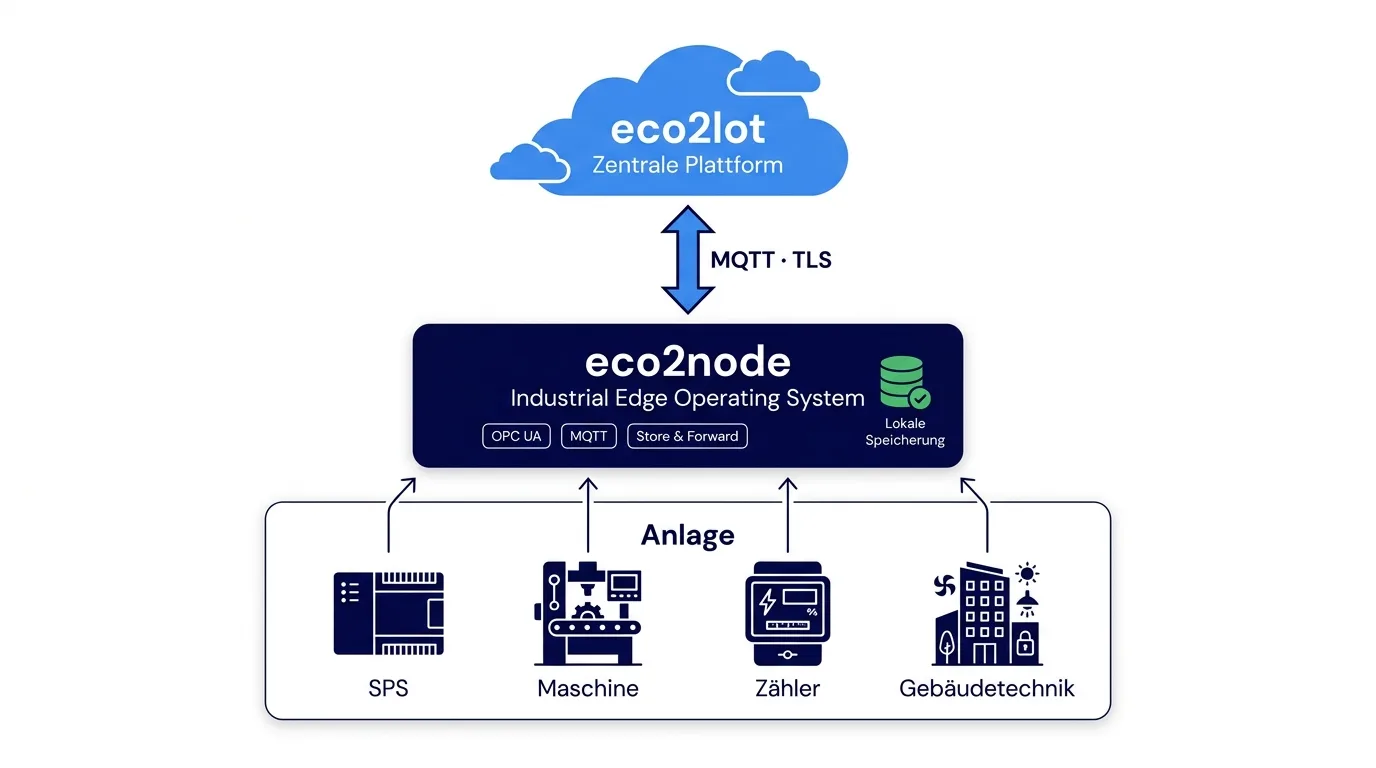
eco2node is a full product in its own right, far more than a platform add-on. You start where it makes sense for you — and keep full sovereignty over your data in both operating modes.
eco2node captures plant data via OPC UA and MQTT and writes the time series directly into your own database — for example SQL or PostgreSQL.
The most convenient path: eco2lot handles configuration, visualization, alarms, and controlled remote access — centrally for all sites.
The path stays open: start standalone and add eco2lot later — same eco2nodes, same data points, zero reinstallation.
Combined, configuration happens entirely through eco2lot. Routine operation works without a separate local setup — the last valid configuration stays stored on each eco2node and also carries offline operation.
A classic IoT gateway translates protocols and forwards data. That is enough as long as the connection stays stable, everyone only reads, and a single site suffices. eco2node is built for everyday industrial reality — and takes over exactly where gateways stop.
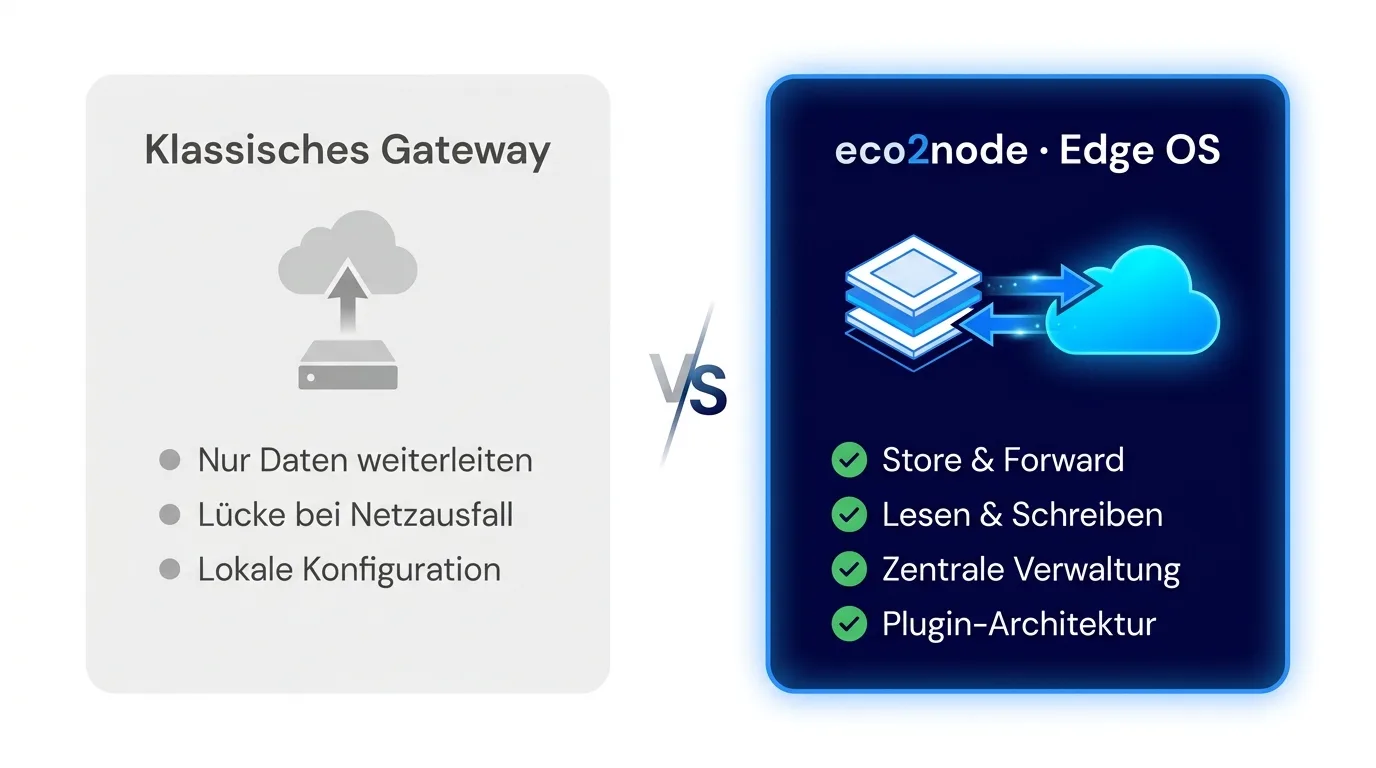
| Classic gateway | eco2node Industrial Edge OS | |
|---|---|---|
| Configuration | usually local, per device | central through eco2lot, for all sites |
| Connection loss | data gap | local time-series storage + store & forward |
| Communication direction | one way: to the cloud | bidirectional — read and write down to the data point |
| Data model | protocol-specific (registers, node IDs) | unified tag IDs with unit, limits, permissions |
| Extensibility | vendor-bound, limited | plugin architecture, independently updatable |
| Fleet operation | device-by-device management | central overview: status, buffers, software versions |
| Perspective | data converter | runtime environment for future edge applications |
For your investment decision this means: a gateway gets replaced with the next use case. An edge operating system grows with you.
eco2node always initiates the connection to the cloud itself. Your plants stay unreachable from the internet — entirely without inbound firewall openings.
TLS-encrypted MQTT, individual certificates, and a unique identity per eco2node. Credentials are stored encrypted, and tenants are strictly separated.
Write access is disabled by default. Each data point needs its own approval with value range, data-type check, and role-based permissions — optionally with dual approval (four-eyes principle).
Unique command IDs, protection against repeated execution, time-limited commands, and complete audit logging — including read-back confirmation from the device.
Capture electricity, gas, heat, and water readings, integrate generation assets, and analyze load peaks centrally — the data foundation for active energy management.
Transmit machine states, operating hours, and production values and visualize them centrally — including the bridge to condition monitoring.
Query plant states, read parameters, change approved values, and narrow down faults faster — with zero travel and zero open ports.
Connect heating, cooling, ventilation, and the energy consumption of technical building equipment — also as an extension of your existing BMS (building management system).
Bring photovoltaics, battery storage, combined heat and power units, heat pumps, and charging infrastructure into one shared view — per site and across portfolios.
You build machines, energy systems, or devices with a long life cycle? eco2node becomes the local software base of your own digital service offering: your devices register securely with your platform straight from the factory — monitoring, diagnostics, and customer portal run under your brand, operated in Germany. This turns sold devices into lasting service relationships with recurring revenue.
Discover the white-label platform for device manufacturersStart with eco2node today and you lay the foundation for monitoring, optimization, and tomorrow's AI applications — on the same base, with a single setup.
eco2node is the Industrial Edge Operating System in the eco2 product family: local software that connects machines, controllers, and meters from different manufacturers to the eco2lot cloud platform. It captures data on site, buffers it locally, and enables controlled remote read and write access.
A gateway translates protocols and forwards data in one direction. eco2node adds local time-series storage with store & forward, bidirectional communication down to each data point, a unified data model, central management of many sites, and a plugin architecture for new protocols.
OPC UA and MQTT at launch. Modbus TCP and Modbus RTU are in development; Siemens S7, BACnet, M-Bus, KNX, REST API, and SQL are planned as further plugins.
eco2node keeps working autonomously: data capture continues with the last valid configuration, and all readings are stored locally. Once the connection is restored, eco2node transfers the buffered data to eco2lot automatically, in chronological order, and free of duplicate transmissions.
Fully centrally through eco2lot. Authorized users define device connections, data points, capture intervals, and write permissions there. The configuration is transmitted to eco2node in encrypted form, then validated, applied, and confirmed. Routine operation works entirely without local on-site setup.
Yes — in a controlled way. Write access is disabled by default; every writable data point needs an explicit approval with a permitted value range. Every command is authorized by role, logged, and on request confirmed by reading the value back from the device (write-and-readback).
Communication runs over TLS-encrypted MQTT, with a unique identity and individual certificates for each eco2node. The connection is always initiated by eco2node toward the cloud — so your plants can stay unreachable from the internet.
Your existing controllers stay in place. eco2node connects legacy systems through open protocols. For matching, tested hardware on site, eco2iot — the curated hardware selection from BS-Systeme — takes care of it on request.
From a single machine to an international fleet with thousands of devices. eco2lot shows online status, connected devices, buffer levels, software versions, and connection quality for every instance — centrally in one overview.
For industrial companies, machine and plant builders, OEM manufacturers, energy utilities, system integrators, facility management, and operators of distributed assets — wherever data from many sources needs to flow reliably into one central place.
Yes. eco2node is a standalone product: it captures plant data via OPC UA and MQTT and writes the time series directly into your own database — for example SQL or PostgreSQL. Your own tools handle the analysis, from SQL queries to BI tools such as Power BI. You can add the eco2lot platform at any later point — with the same eco2nodes and data points.
Yes. As an OEM or white-label partner, you use eco2node as the local software base for your own cloud and service offering — including a customer portal under your brand, operated in Germany.
The eco2node base will grow into local control functions, virtual data points, local alarming, anomaly detection, and edge analytics. These features are a future perspective and are deliberately labeled as "planned" today.
In a 60-minute call we clarify which systems you want to connect, where data gaps appear today, and what a pilot site with eco2node looks like. You receive a concrete target picture — ahead of any decision.
Book a demo