"Our competitor has an app now."
Tenders and dealer conversations increasingly revolve around the digital layer: portal, app, remote access. Hardware alone loses points — even when your device is the better one.

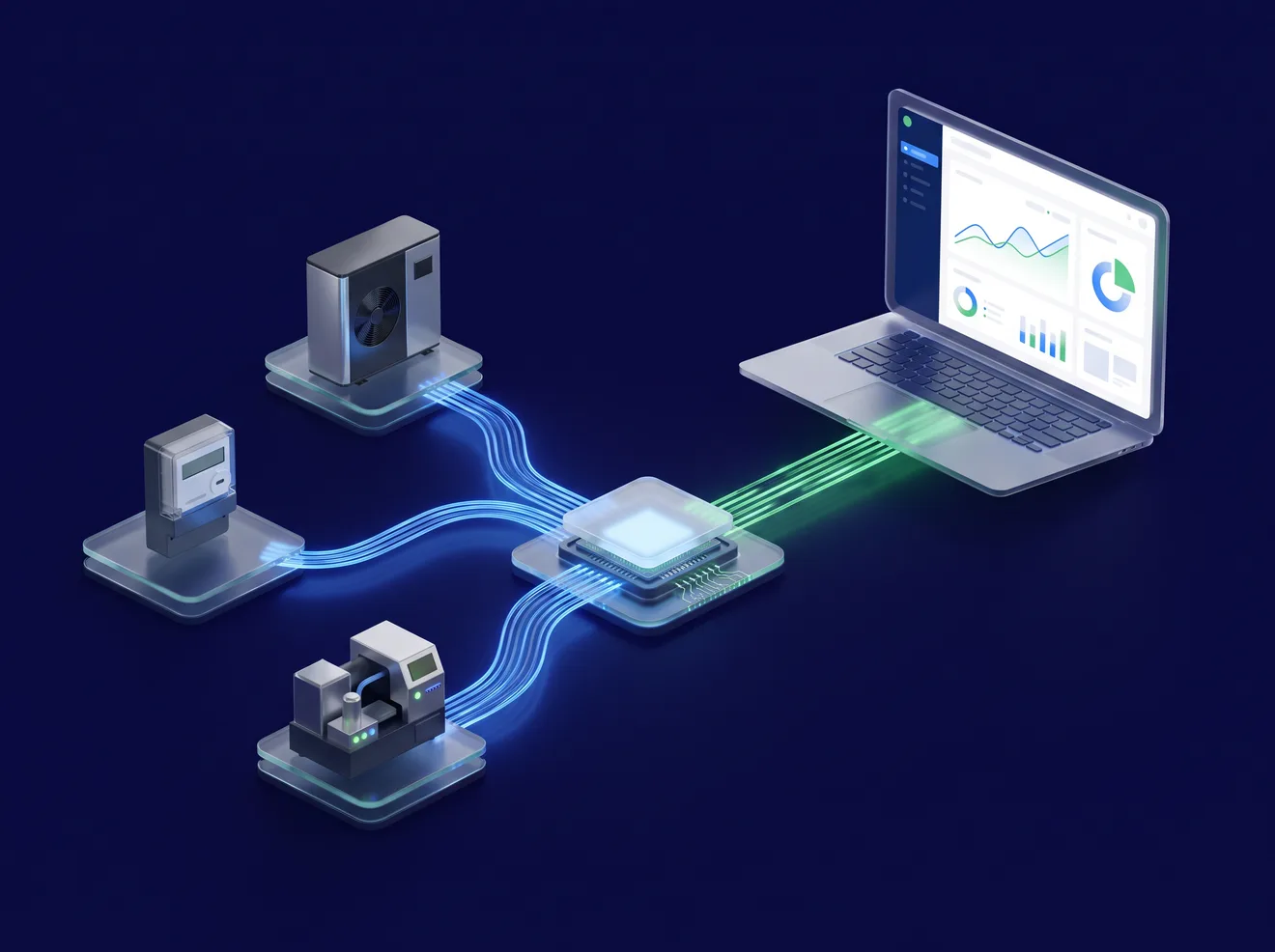
Your customers get a portal, an app, and remote monitoring for your devices — under your brand, on your domain. Developed, hosted, and operated by BS-Systeme in Germany. You launch a digital service business in around 90 days, with the cloud team on our side.
Three sentences we hear again and again in conversations with manufacturers — they may sound familiar.
Tenders and dealer conversations increasingly revolve around the digital layer: portal, app, remote access. Hardware alone loses points — even when your device is the better one.
Without remote monitoring, every fault means a call and every diagnosis a site visit. With a live view of the data, many cases are resolved remotely — and the remaining visits start well prepared.
Building your own platform means finding developers, operating a cloud, shipping security updates, staffing support — permanently. An OEM software partnership hands exactly that part to us, so you stay a manufacturer.
A white label IoT platform is finished software that a manufacturer offers to its customers under its own brand, its own domain, and its own product name — developed and operated by a software partner in the background. eco2lot OEM is such a platform for device manufacturers: it connects devices in the field to a customer portal and delivers monitoring, alerting, service, energy analytics, and compliance records as ready-made processes. "Fully operated" means: BS-Systeme handles hosting, updates, security, and second-level support — as a managed service from Germany.
eco2lot OEM connects your devices and brings the operator, service, and compliance processes along. That sets the platform apart from toolkits that stop at dashboards.
Web portal and mobile app with your logo, your colors, your domain, and your product name. White label, your sender — for customers, dealers, installers, and service partners.
Live status of every device in the field, fault alerts with escalation chains via email, SMS, or push. Dashboards and reports your customers understand without training.
The installer scans the QR code on the type plate, the device registers, the customer is connected — serial-number activation instead of an IT project. Your connected fleet grows with every device you sell.
Every device keeps its file: jobs, maintenance, spare parts, documents. Your service team sees the history before the drive — your service partners work from the same record.
Consumption, load profiles, and efficiency KPIs per device and site — embedded analytics built on 15 years of energy software experience. Your customers use the data directly for their energy and sustainability reports.
A digital product file with unique identification, documents, and inspection records — the precursor to the digital product passport under the EU Ecodesign Regulation (ESPR), whose obligations the EU phases in step by step.
Your sales reality has several levels — the platform mirrors them. Multi-tenancy means: everyone works on one platform, and each party sees only its own data room. You as the manufacturer keep the full view of the installed base — anonymized wherever end-customer data must stay protected.
New IoT devices publish via MQTT, existing devices speak Modbus or M-Bus — the platform takes both. In brief: MQTT is the lightweight messaging protocol of the Internet of Things, OPC UA the industry standard for machine data, Modbus the automation classic, and M-Bus (EN 13757) the European standard for utility meters.
M-Bus support out of the box is rare. Most IoT platforms handle the metering standard M-Bus only through workarounds, if at all. For manufacturers of energy meters, heating, cooling, and building technology, the native M-Bus support in eco2lot OEM is a tangible head start — including field experience from projects such as the M-Bus extension of an existing building management system.
Three paths lead to your own device platform. The difference lies in who builds, who operates — and how fast your customers benefit.
| Platform toolkit | Custom project | eco2lot OEM | |
|---|---|---|---|
| You get | tools and building blocks | tailor-made software | a finished, branded platform |
| Who configures and builds | your team (expertise required) | a contractor, to your specification | BS-Systeme, with your branding |
| Who operates and supports | your team | depends on the contract — often you | BS-Systeme (managed service, 2nd level) |
| Time to customer launch | months to years | usually 12–24 months | around 90 days |
| Cost model | license + internal effort | project budget + operations | setup + predictable monthly fee |
| Energy & compliance processes | build them yourself | part of the project scope | included, ready to use |
Assessment based on publicly available vendor information and our project experience; details vary by vendor. A detailed decision guide, "Build or buy an IoT platform", is on its way.
Devices, sales structure, tenant model, pilot customers. Outcome: a concrete implementation plan at a fixed price.
Your brand, your domain, your wording. In parallel, we connect the first device types — via MQTT, Modbus, M-Bus, or OPC UA.
10 to 50 devices at selected customers, QR onboarding in a field test, alert chains and reports in live operation.
The portal goes live, your team receives training and sales material. From now on, the fleet grows with every device sold.
eco2lot OEM fits manufacturers with long-lived, complex devices in the field — from meters to full systems. We go deepest in these fields; detailed industry pages are coming soon.
Remote monitoring, fault alerts, maintenance contracts with digital value — plus documentation duties such as F-gas leak checks handled digitally.
Remote meter reading, submetering, and native M-Bus — with experience in legally compliant metering data chains and energy data end customers actually use.
Service portal, machine file, and remote diagnostics for your installed base — proven in cooperations with machine-building partners such as MBS-MP and AES.
The fastest route is a white label IoT platform: a software partner provides the finished platform — portal, apps, device connectivity, operations — and the manufacturer contributes brand, domain, and device expertise. With eco2lot OEM, a branded customer portal goes live in around 90 days, and the manufacturer avoids building its own cloud, DevOps, or support team. The alternative — developing a platform in-house — typically takes several years and ties up development capacity permanently.
With a white label platform, you use finished, continuously developed software under your own brand — time to market around 90 days, predictable monthly costs, with operations and security handled by the provider. With in-house development, you own every line of code, and you carry development (typically several person-years), operations, security updates, and further development yourself. For most manufacturers with 30 to 1,000 employees, white label is the more economical route — customization stays possible through open APIs.
That is your decision. The standard is full white labeling: your brand, your logo, your colors, your domain (for example portal.your-brand.com), and your product name. Your customers, dealers, and service partners move entirely within your brand world. BS-Systeme works in the background as your technology and operations partner — including second-level support for your team.
Out of the box: MQTT, OPC UA, Modbus TCP/RTU, M-Bus (EN 13757), BACnet, KNX, and REST APIs. This connects modern IoT devices as well as existing equipment. A special strength: M-Bus is supported natively — important for manufacturers of energy meters, heating technology, and building technology. Open, documented APIs are available for your own integrations; your data stays exportable at all times.
The standard is operation in a German data center, GDPR-compliant with a data processing agreement. Alternatively, we run the platform in an EU cloud of your choice or on-premises in your infrastructure. In every variant, BS-Systeme handles operations, monitoring, updates, and backups as a managed service.
The platform mirrors your real sales structure: you as the manufacturer see everything, your distributors see their customers, installers and service partners see the assets they manage, and end customers see their own devices. Each level has its own accounts, permissions, and visibility — cleanly separated and GDPR-compliant. Multi-tenancy means: one platform, strictly separated data rooms.
Your data belongs to you: full data export through open APIs and standard formats is guaranteed by contract. On request, we additionally agree on terms for an operations handover. As a German vendor with over 15 years of industrial software experience, we build long-term partnerships — and we keep the exit clean, because exactly that builds trust.
Yes. The EU Ecodesign Regulation (ESPR) makes the digital product passport mandatory step by step; the EU DPP registry has been operating since July 2026. eco2lot OEM already provides the required foundation: unique device identification, QR code access, a digital product file with documents, and maintenance and service history. Your product program is prepared when the obligations reach your product group.
30 minutes, free of obligation: we show the platform in your branding scenario and calculate together what a 90-day launch means for your product program.