Customer portal software for device manufacturers

Customer portal software for your technical devices and systems —
under your brand.

End customers see their systems live, installers see their sites, dealers see their territory — and your service team sees everything it needs before the drive. One customer portal, four perspectives, operated by BS-Systeme in Germany.

  • White label: your domain, your logo
  • QR onboarding built in
  • Hosted in Germany
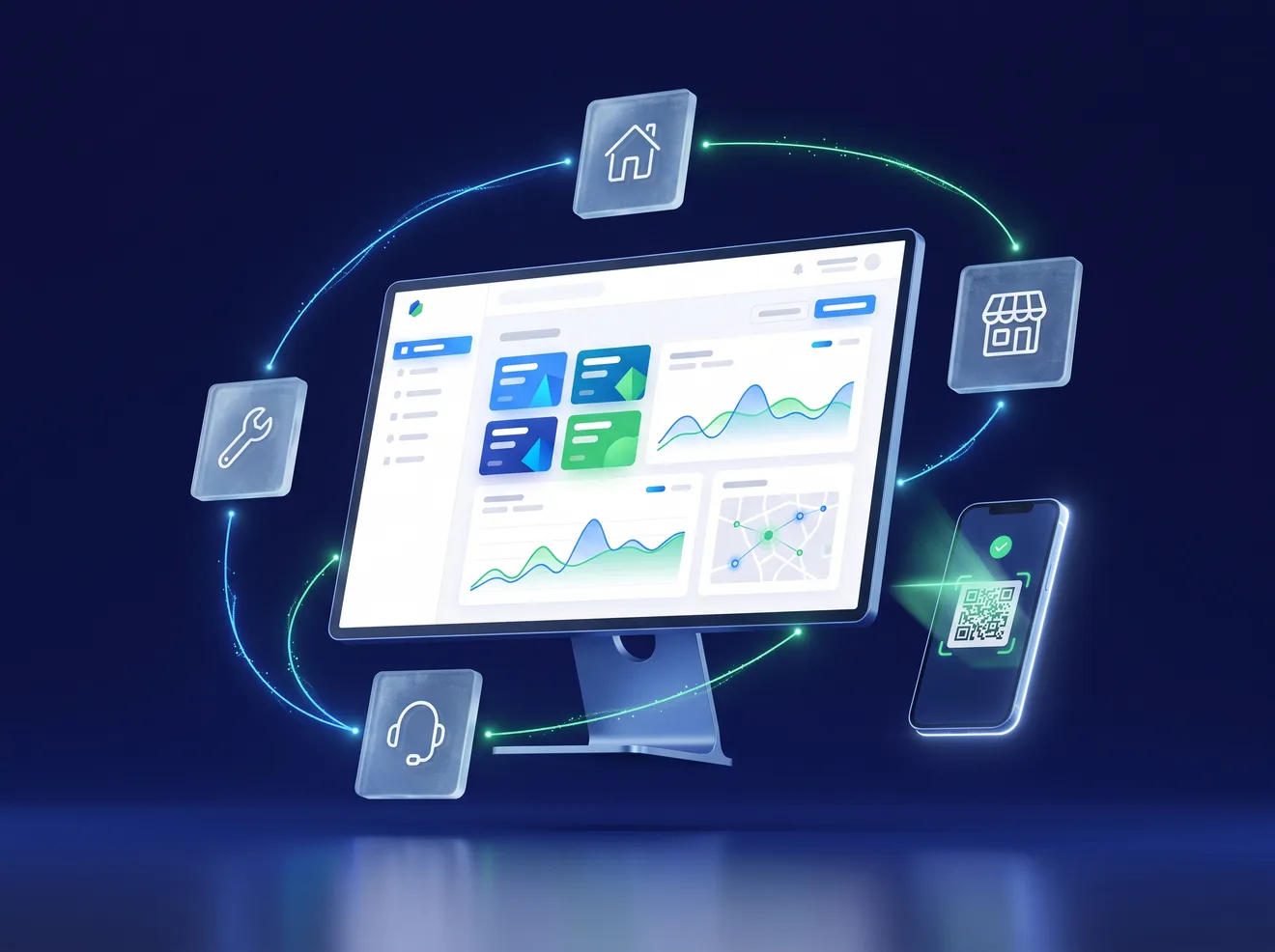
Illustration: branded customer portal dashboard with access for end customer, installer, dealer, and service, plus QR code activation on a smartphone
In short

A customer portal for technical devices and systems is your customers’ digital access to your products in the field: live status, consumption, alerts, documents, and maintenance history — on the web and as an app. The distinction matters, because "customer portal" alone often means the opposite: a general B2B portal for orders, invoices, and price lists. An IoT customer portal puts the device at the center, ahead of the order. Both worlds connect cleanly — via API between portal and ERP.

The reasons

Six reasons manufacturers should run their own customer portal

A customer portal is more than a digital business card — it changes how you sell, service, and improve your products. These are the six levers manufacturers confirm to us again and again.

01 The customer interface stays with you

Where your customers view their device data, loyalty grows. When that view runs through third-party platforms or a competitor’s app, the relationship belongs to someone else from that moment on. Your own portal keeps brand, data, and customer contact in your hands — at every login.

02 Recurring revenue on top of one-off sales

Monitoring subscriptions, digital maintenance contracts, premium analytics: the portal turns into predictable monthly revenue across the entire device lifetime. With long-lived devices this adds up over years — and makes your business more independent of new-sales cycles.

03 Service costs drop noticeably

With a live view of the device, many faults are resolved remotely, and the remaining visits start well prepared — right spare part, full history. Your technician capacity grows while your headcount stays the same.

04 The portal sells with you

Tenders and dealer conversations now ask for digital services explicitly. A white label customer portal with its own app is a visible differentiator — and gives dealers and installers a reason to recommend your devices over the competition’s.

05 Field data makes your products better

How are devices really operated, which faults cluster, which features stay unused? The installed base answers questions no lab test asks — insights for product development, quality assurance, and targeted warranty decisions.

06 Compliance obligations are prepared

Unique device identification, QR access, documents, and service history — exactly the building blocks the upcoming digital product passport under the EU Ecodesign Regulation (ESPR) requires. Run a portal today, and tomorrow you meet obligations from your existing setup instead of launching an emergency project.

Four perspectives

Every role gets exactly the view it needs

For your end customers

System status at a glance, downloadable consumption and energy reports, fault alerts explained in plain language, manuals and certificates attached to the device. The portal keeps your product visible every day — long after the sale.

For installers & service partners

Commissioning via QR scan, all managed assets in one list, remote diagnostics before the drive, maintenance history and spare-part info on the device. Your partners work faster — and bond more closely with your brand.

For dealers & distributors

An overview of devices and customers in their own sales territory, activation numbers as a sales signal, and a shared view with your sales team instead of Excel lists by email.

For your own service team

The entire installed base with live status, alert escalations to the right person, serial-number search, a device file with every job. "The customer calls" becomes "we knew first".

Device onboarding

From type plate to portal — in three steps

Onboarding means connecting a new device to the platform and assigning it to the right customer. With eco2lot OEM, that is one action on site instead of an IT project.

  1. Step 1

    Scan

    Scan the QR code on the type plate — it carries the device’s serial number and activation key.

  2. Step 2

    Assign

    The portal recognizes device type and delivery route and suggests customer, site, and installer — confirming is all it takes.

  3. Step 3

    Live

    The device transmits, dashboards fill, alert chains are active. The end customer receives access credentials automatically.

Features

What the portal includes

  • Live monitoring: status, readings, and trends per device and site
  • Alerting: fault alerts with escalation chains via email, SMS, push
  • Reports: energy and consumption analytics, schedulable as PDF delivery
  • Device file: maintenance and service history, documents, certificates
  • User management: roles and permissions across all tenant levels
  • Open APIs: REST and webhooks for ERP, CRM, and ticketing systems
  • Your brand everywhere: domain, logo, colors, app icon, email sender
Operations included

You get a running portal, operated end to end. Hosting in a German data center, updates, security, backups, and second-level support are handled by BS-Systeme. Your team answers customer questions about the application — everything behind it is our job. More on the model on the platform overview for manufacturers.

Prepared for the digital product passport: the device file with unique identification and QR access is the precursor to the DPP under the EU Ecodesign Regulation (ESPR) — whose obligations the EU phases in from 2027.

Frequently asked questions

Questions about the customer portal

Why should a hardware manufacturer run its own customer portal?

Six reasons speak for it: First, the customer interface stays with your brand instead of drifting to platform providers or competitors. Second, digital services create recurring revenue on top of one-off device sales. Third, service costs drop, because remote diagnostics replace many site visits. Fourth, the portal scores in sales — tenders increasingly ask for digital services explicitly. Fifth, field data delivers insights for product development and quality. Sixth, you build the data infrastructure for upcoming obligations such as the digital product passport along the way.

What is customer portal software for device manufacturers?

A customer portal for device manufacturers is a web and app interface through which end customers, dealers, installers, and service partners access the manufacturer’s devices: live status, consumption, fault alerts, documents, maintenance history. Unlike a general B2B customer portal (orders, invoices), this IoT customer portal centers on the devices in the field. With eco2lot OEM, the portal runs under the manufacturer’s brand and domain — BS-Systeme operates the platform behind it.

How do my customers’ devices get into the portal?

Through serial-number activation: every device carries a QR code on its type plate. The installer or end customer scans it, the device registers with the platform and is automatically assigned to the right customer, installer, and sales territory. Existing devices with limited connectivity can be retrofitted via gateways with Modbus, M-Bus, or OPC UA.

Can each user see only their own devices?

Yes — multi-level multi-tenancy takes care of that. End customers see their devices, installers the assets they manage, distributors their sales territory, and you as the manufacturer the entire installed base. Each level has its own accounts and permissions; the data rooms are strictly separated and built GDPR-compliant.

Can the portal connect to our ERP or CRM?

Yes. Through open REST APIs, the portal exchanges data with ERP, CRM, and ticketing systems — for example, importing serial numbers and customer assignments from the ERP, or handing fault alerts to service as tickets. Webhooks notify your systems about events in real time.

Should our customer portal be free or paid?

A tiered model has proven itself: a free basic tier (device status, documents) that makes portal use a matter of course, plus paid tiers for added value — advanced analytics, alerting, maintenance packages, API access. This way the portal funds itself and becomes a source of recurring revenue. In the target-picture workshop, we calculate concrete pricing models for your product program.

How fast is a branded customer portal ready to use?

Around 90 days from the target-picture workshop to launch: branding and domain in the first weeks, device connectivity in parallel, then a pilot with 10 to 50 real devices, followed by the rollout. This pace is possible because the platform is finished — we configure your branding, your tenant model, and your device types, and develop only what truly differentiates you.

See the portal with your logo.

In a 30-minute demo, we walk through the customer portal using your product program — with your branding scenario on request.